
Artist or Service Provider? | Erik Stenzel on Freedom and Self-Determination as a Musician

Backstage Wisdom Podcast • EP 6
From climate researcher to singer-songwriter — and how Erik Stenzel found his own why, and with it, his freedom
Erik Stenzel could have become a climate protection manager. Spreadsheets, a steady desk job, a role with real social relevance — at least on paper. Instead, he chose something that looks like the riskier path to most people: he became a singer-songwriter.
Erik studied geography, with a master's thesis in climatology — and along the way, experienced firsthand how wide the gap is between scientific knowledge and actual social change. That gap turned into a kind of anger, which he now channels into music: sometimes subtle, sometimes direct, but always with a clear stance. He's been releasing his own albums since 2020, tours completely independently — sometimes even by bicycle — and has deliberately opted out of the traditional music business system.
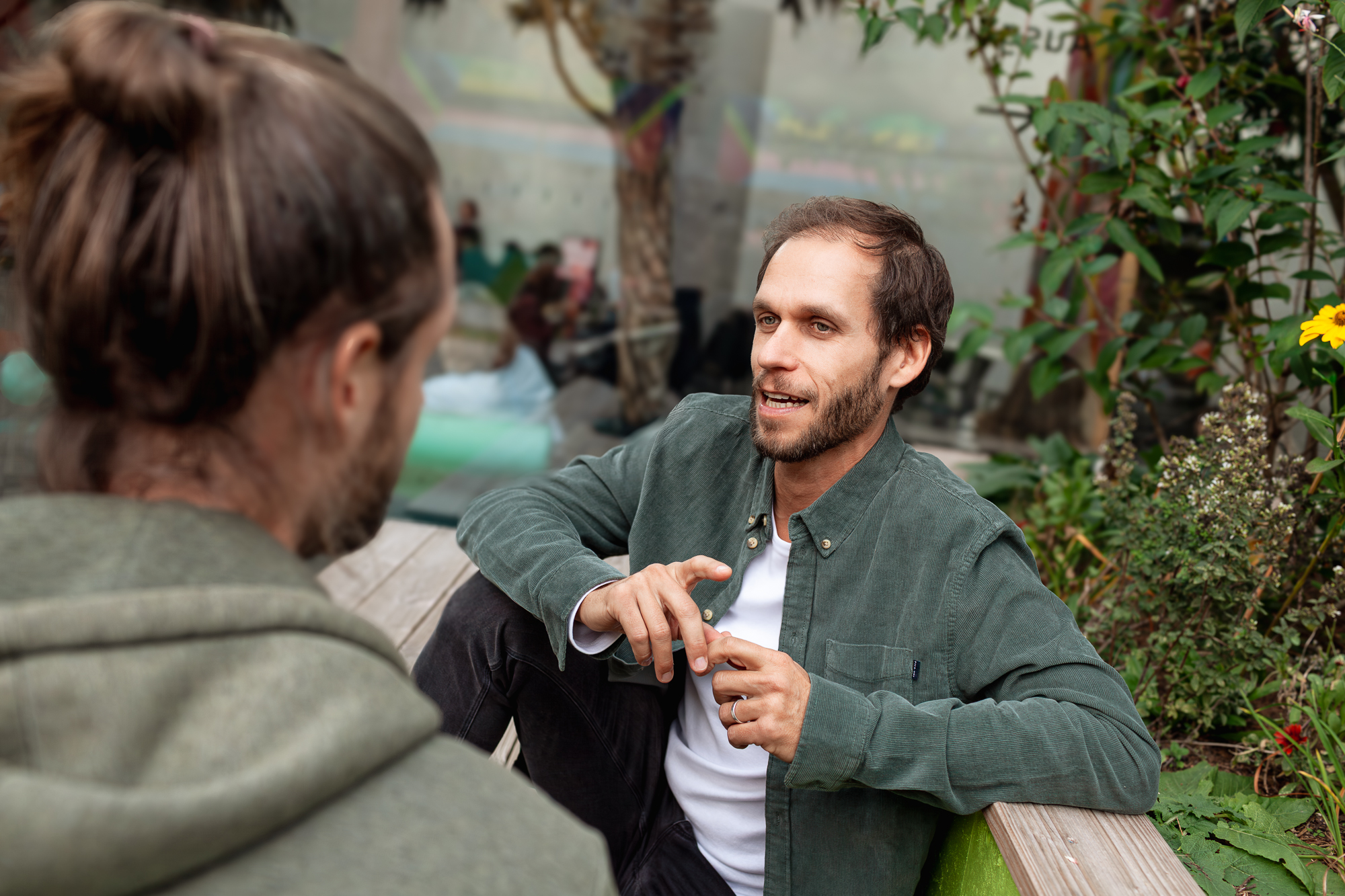
In this Backstage Wisdom Podcast conversation with Marco, Erik speaks openly about a distinction that still guides him today: the one between artist and creative service provider. We talk about what separates genuine artistic expression from simply meeting demand, how he turned his anger about injustice into a sustainable career, and the very concrete routines — journaling, meditation, radical offline time — that keep him from losing himself in "being a musician," staying connected to who he actually is instead.
🎧 Listen to the full conversation on the Backstage Wisdom Podcast. 🇩🇪 This episode is in German.
Key Takeaways
Artist or Service Provider? Why this distinction matters for your musical path
Erik draws a line between two mindsets in his own work: making music to meet a demand — dance music, comfort pop, the next viral format — is, in his view, working as a service provider. Making music to express something that wants to come out of you is, for him, being an artist. Both are legitimate, he says — but only if you know which one you're doing can you consciously choose your own path.
Your why can carry you further than any career plan
Erik Stenzel could have had a secure job as a climate protection manager. Instead, he followed the realization that he could act more freely for his cause as an artist than inside an employee system. A clear why can carry you where security and status can't.
Mental clarity as a musician starts with small routines
Journaling, a short meditation, time in nature, radical offline stretches in winter — Erik's strategies for his own wellbeing are deliberately unspectacular. They help him stay connected to himself instead of over-identifying with "being a musician."

Deep Dive
Artist or Service Provider? A Question Worth Asking Yourself
Are you doing this because it wants to come out of you — or because it's currently in demand? The question sounds simple. It isn't. Because the honest answer changes how we make music, who we're trying to please with it, and what we end up measuring our success by.
Erik Stenzel draws a line between two mindsets: making music to meet a demand — dance tracks, comfort pop, the next viral format — is working as a service provider. Making music to express something coming from within is being an artist. Both are legitimate. But only once you know where you actually stand can you consciously choose which pull to follow.
Most of us don't start out as artists. We start out wanting to be seen — the stage, the applause, the feeling of mattering. Erik describes his own early years the same way. It took a detour — engaging with the climate crisis, a growing awareness of injustice — before the drive shifted toward something he genuinely wanted to say.
Maybe that's the real point: "Artist or service provider?" isn't a question you answer once and move on from. It comes back — with every new song, every booking offer, every request to "make something a bit more commercial." Whoever keeps asking it anyway stays in control of their own direction, instead of quietly drifting into the market without noticing.
Your Why Can Carry You Further Than Any Career Plan
What would you give up if you knew your why was strong enough to carry you? Most of us choose the safe path before we ever seriously ask ourselves that question. A steady job, a predictable salary, a position that looks responsible and right — at least on paper.
Erik Stenzel could have taken exactly that path. After his master's in geography with a focus on climatology, a job as a climate protection manager was within reach — socially relevant work, at least on paper. He chose music instead. Not because he looked down on the safe route, but because he felt he could achieve very little behind a desk with a spreadsheet — while as an artist, he'd be free enough to make his contribution.
That freedom isn't an abstract concept. It shows up concretely in his first album: the songs came together almost effortlessly, because each one had a clear why behind it. He wasn't driven by commercial success, but by the feeling that a song might actually move someone.
A strong why doesn't replace a career plan — but it often carries you further than any plan alone. It keeps you going even when success hasn't arrived yet, because the motivation isn't coming from outside, it's coming from within. The real question, then, isn't "what's the safest path?" but: what's worth taking the uncertainty on for, for you personally?
Small Routines Against the Weight of Self-Identification
Who are you when you're not playing a show, not promoting an album, not booking a gig? The question sounds almost trivial — until you try to actually answer it. Because the more our daily life consists of music, the easier it becomes to blur the line between what we do and who we are.
Erik describes himself as a content person who regularly experiences real happiness — especially when he manages not to over-identify with "being a musician." His strategies for that are deliberately unspectacular: journaling in the morning, a half-hour walk, a short meditation — sometimes just a few seconds of mental stillness, triggered by the simple question of what his next thought might be. On top of that, plenty of time in nature, and once a year, a radical retreat: at least a month, no phone, no computer.
He's strikingly honest about his own limits, too: he admits he still struggles, more than some fellow artists, to let anything truly personal into his lyrics — he tends to stay too much in his head, even though he wishes he could write closer to his own experience.
That might be the real practice: not being perfect at staying connected to yourself, but sticking with it. Small, repeatable routines build, over time, something a single big success never can — a stability that doesn't depend on the next round of applause.
Continue the Conversation
The best conversations don't end when the episode is over. They continue in the questions we ask ourselves.
1. Journal prompt: Write freely for 10 minutes on this question: "Does my musical life have a clear, intrinsic motivation — or am I mostly just serving a market?"
2. Mindfulness practice: This week, take 15 minutes offline every day — no phone, no distractions — and notice what surfaces in that quiet. It's especially powerful right after waking up or just before falling asleep.
3. Reflection: If you could shape your touring life to truly match your values — what would you change?
Keep Exploring
Did this conversation resonate with you?
On the Backstage Wisdom Podcast, Marco Hohner speaks with musicians and experts about the realities of life behind the stage – through honest, thought-provoking conversations that go beyond easy answers.
Your Backstage Journey
Every musician's path is unique. So are the challenges that come with it.
If you're looking for greater clarity, confidence and balance – both on and off the stage – discover Marco Hohner's holistic Coaching for musicians.